
Love

Mostrando postagens com marcador ways. Mostrar todas as postagens
Mostrando postagens com marcador ways. Mostrar todas as postagens
18/01/2020
09/02/2019
33 ways to speak better English without taking classes

By speaking better English, people all over the world can hear our voice.
Here are 33 ways to speak better English:
1. Record yourself speaking English. Listening to yourself can be strange at first but you get used to it. Listen to a recording of a fluent English speaker (a short audio file) and then record yourself repeating what they said. Compare the difference and try again. Humans are natural mimics so you will find yourself getting better and better. Soundcloud is an excellent tool for voice recording as you or your teacher can make notes about your errors.
2. Read aloud, especially dialogue. Reading aloud is not the same as speaking naturally. However, it is very useful for exercising the vocal muscles. Practise for 5 or 10 minutes a day and you will begin to notice which sounds are difficult for you to produce. Find transcripts of natural dialogues, such as these here, and practise acting them with a friend, you will also learn common phrases which we use when speaking.
3. Sing along to English songs while you’re driving or in the shower. The lyrics to pop songs are often conversational so you can learn lots of common expressions by listening to them. Humans are also able to remember words when used together with music which is why it is difficult to remember poems but easy to remember the words to songs. Here are some songs to get started with.
4. Watch short video clips and pause and repeat what you hear. YouTube is an amazing resource for language learners and you probably already have your favourite clips. My advice is to watch short clips and really study them. With longer videos, you may find your attention wanders. The key to improving by watching videos is to really listen carefully and use the pause button to focus on sounds and words. Many YouTube videos now have captions.
(...)

09/10/2018
10 Ways to celebrate Childrens' Day

1. Attend a free Children’s Day event
Children’s Day doesn’t need to be expensive - there are lots of events happening throughout the country. To see what events are on near you check out the Children’s Day website www.childrensday.org.nz.
2. Have a dress up in the Children’s Day theme
Get dressed up in silly clothes, have a treasure hunt and make sure you take some fun silly photos to hang in the children’s bedrooms.
(...)
06/02/2018
#Modern #Ways For #Teachers to #Make #Extra #Money

1. Start your own blog
2. Sell your teaching materials
3. Become an Uber driver
4. Rent out your car
(...)
11/06/2017
33 WAYS TO SPEAK BETTER ENGLISH – without taking classes

When we communicate effectively we are able to express our ideas and opinions, share experiences, and build relationships with others. When we struggle to express ourselves, we feel unvalued and insecure. As human beings, we want to participate in group discussions and have an impact on the society around us. Well, English teachers and English classes definitely help. But, studying English for a few hours a week may not improve your spoken English very much.
What you need is to become a self-directed learner, somebody who takes responsibility for their own learning and creates their own learning programme to develop their English.
Here are 11 (OUT OF 33) ways to speak better English, without going to classes.
1. Record yourself speaking English. Listening to yourself can be strange at first but you get used to it. Listen to a recording of a fluent English speaker (a short audio file) and then record yourself repeating what they said. Compare the difference and try again. Humans are natural mimics so you will find yourself getting better and better. Soundcloud ttps://soundcloud.com/ is an excellent tool for voice recording as you or your teacher can make notes about your errors.
2. Read aloud, especially dialogue. Reading aloud is not the same as speaking naturally. However, it is very useful for exercising the vocal muscles. Practise for 5 or 10 minutes a day and you will begin to notice which sounds are difficult for you to produce. Find transcripts of natural dialogues, such as these here http://www.teacherjoe.us/NYBJ.html, and practise acting them with a friend, you will also learn common phrases which we use when speaking.
3. Sing along to English songs while you’re driving or in the shower. The lyrics to pop songs are often conversational so you can learn lots of common expressions by listening to them. Humans are also able to remember words when used together with music which is why it is difficult to remember poems but easy to remember the words to songs. Here are some songs to get started with. http://www.teachingenglish.org.uk/article/phonemic-ch..
20/12/2016
33 ways to speak better English – without taking classes

When we communicate effectively we are able to express our ideas and opinions, share experiences, and build relationships with others. When we struggle to express ourselves, we feel unvalued and insecure. As human beings, we want to participate in group discussions and have an impact on the society around us.
In the modern world, we communicate across borders. English is the closest thing we have to an international language.
By speaking better English, people all over the world can hear our voice. But, to speak better English, you need a teacher, don’t you? You need to take English classes, right?
Well, English teachers and English classes definitely help. But, studying English for a few hours a week may not improve your spoken English very much.
What you need is to become a self-directed learner, somebody who takes responsibility for their own learning and creates their own learning programme to develop their English.
06/07/2015
35 WAYS TO INTRODUCE YOUR LESSON TOPIC
Are you fed up with using the same old methods to introduce your lesson topic? Look no further! Here are 35 ways to kick off your lesson. How many have you tried?
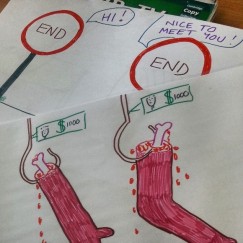
You know I play football, right? No? Well I love it. Anyway, I went into town to buy some new boots the other day. I’m in Sports Direct, and I see these Nike boots that I really like, they’re the new model. The assistant comes over and is like
“can I help you?”
And I’m “yeah. Can you tell me how much these are?”
She says “They’re £500”
And I said “£500???? That’s an arm and a leg!”
Here’s some example flashcards I made for teaching idioms. These could also be used for a ‘dingbats’ warmer (see number 22).
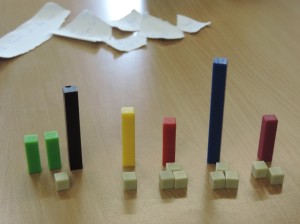
Give each pair of students a bunch of Cuisenaire rods.
“Work in pairs. Use the rods to create a model of a well-known tourist attraction in [town/city/country/continent]. You have 2 minutes”
Students then look at each model and guess the attraction.
(Here is my example of the UK political parties and their share of the vote, for a recent lesson on politics)
Think of 3 or 4 songs which in some way reference the theme/topic of your lesson
Avril Lavigne – Skater Boi (“he was a boy, she was a girl, can I make it any more obvious?”)
The Hollies – He ain’t heavy (he’s my brother)
Baz Luhman – Everybody’s free to wear sunscreen (“maybe you’ll marry, maybe you won’t…”)
Ozzy Ozbourne – Mama I’m coming home
Play students a relevant segment of the song (where something about the topic is referenced). Ask them to write notes on what they hear, compare notes, and guess the topic of the lesson.
Create a fake family fortunes style question:
“We asked 100 people from England, Scotland and Wales – which things make you a typical Brit?”
Board the following
1 ________________ 2 ____________ 3_____________ 4____________ 5____________
Students work in groups to prepare answers. Make it a little game (they win points for each correct answer).
Five possible answers for the above: queuing, drinking tea, talking about the weather, eating fish and chips, having bad teeth.
Make some extreme close-up pictures of animals. Pass them around and get the students to guess what they are and hence the topic of the lesson
Gather pictures of things that people MIGHT do only once in a lifetime.
Examples: drive a Ferrari, skydive, run a marathon, win the lottery(?), see a shooting star(?).


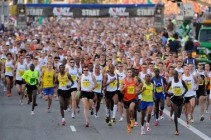

Board the pictures or pass them round, students discuss each one and guess the common theme.
Think of a relevant starter sentence and have students complete in their own words
“The most common time to say sorry is….”
Topic: 2nd conditionals
“If I looked like David Beckham, I would…”

Get students to create a table with two categories
Read a list of different foods/drinks. Students write each word you dictate into their table in the correct category depending on their tastes. They then compare with their partner/group to see if they are similar or different.
Example topic: the royal family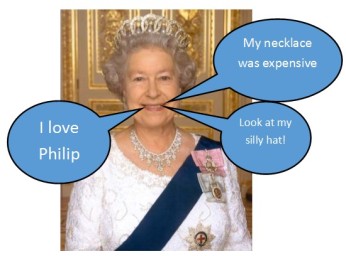
You could also do a caption competition
Make a series of questions or statements related to the topic. Have students answer the questions themselves. Then, they ask their partner the questions and compare answers. They could do this with two different partners to add more speaking. They could even predict their partners answers first, and see if they were right.
Example topic: fears/phobias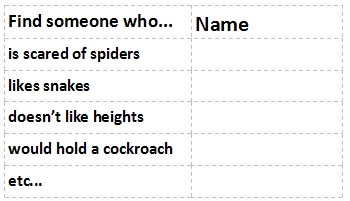
‘A snake’, ‘a line’, etc.
Encourage creativity. Add the next line, encourages guesses, keep doing this until eventually a student guesses the picture/lesson topic
Example topic: Castles in Britain

Bring in 5 items that represent your own hobbies, can students guess pastimes?
Mine – Bit of wool (knitting), keyboard (blogging), crossword, binoculars (birdwatching), rubber chicken (making jokes)
Example topic: using modal verbs to express probability
Pause clip after 7 seconds. Students discuss what might happen. Give some process language (that player might… it might… maybe… the ball/the player/a fan will… etc). Or give them 3 options for what might happen. Play clip to see if prediction was correct (note: last 10 seconds of this video has some swearing).
Example topic: feelings/emotions
Listen to the following clip. Write down any emotions you feel the speakers express.
Or
Listen to the clip. Circle all the emotions that speakers show
Excitement anger patience shock humour etc
Now let them watch the clip and write down any extra emotions they ‘see’
Example topic: giving advice
Example topic: passives
Match the inventions to the inventor…
The light bulb was invented by… Alexander Graham Bell
The telephone was invented by… Tim Berners-Lee
The internet was invented by… Thomas Edison
Etc…
Example topic: Solar System – the planets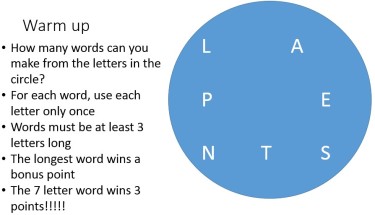
Stand near the door if you agree
Stand in the corner over there (point) if you strongly agree
Stand near Pedro’s desk if you disagree
Etc
Read a statement, students move to the relevant corner, then give them 1 or 2 minutes to discuss the statement with whoever is in the corner. If there is only one person in a particular space then you could bounce a few ideas from each corner as a class discussion, or send a student with a different opinion over to debate it.
Example topic: technology.
Draw a few dingbats on the board. Students guess the words then guess what the theme of the lesson might be.
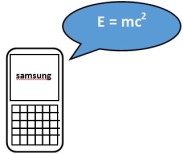
(smart phone)
Q1: Do you agree with the death penalty?
Q2: ‘life means life’. What does this refer to, and do you agree?
Etc.
Example topic: television
Coffeepot was invented in the 1920s, but became popular after World War 2. At first, coffeepots were black and white, but then it changed to colour. Coffeepot is a form of entertainment. These days, almost every household has a coffeepot. (etc…)
Example topic: MacDonalds
Student: is coffeepot a noun?
Teacher: yes…
Student: can coffeepot be a verb too?
Teacher: no
Student: is coffeepot an object?
Teacher: well, you can have a coffeepot, yes.
Student: is it a place?
Teacher: is what a place?
Student: sorry, is coffeepot a place?
Etc…
Example topic: how and when to apologise
Example topic: Feelings
F –antastic
E –xcellent
E – lated
L –azy
I – nsecure
N- auseous!
G- utted
S –tupid
Example topic: health and fitness
Smoking, running, drugs, red wine, football, movies, reading, clubbing, vitamins, snakes, vegetables, birdwatching
Possible student created categories:
Things that benefit your health Things that damage your health unrelated words
(playing) football clubbing (too much) snakes
Smoking (relieve stress) drugs
Reading (relaxation) etc
With this activity, you’ll be surprised at some of the categories. Also, it leads to instant discussion:
‘Snakes are not unrelated, they could seriously damage your health’
‘Smoking is good for you?! No way!’
Etc
Example topic: lookalikes
Definitions…
Group 1: like a look (?)
Group 2: to look like something or someone
Group 3: look and act like something
Group 4: be person not you famous (?)
If the topic is particularly familiar or the learners are high level, get them to think of the statement and create the organisation task (statement minimum 8 words or something).
Board 4 or 5 common words related to the topic. Have students decide which word is the odd one out and why. Example topic: jobs/ambitions
Fireman Doctor Teacher Nurse
Student: the odd one out is the teacher as the others save lives
For guessing the topic…
Same thing, but include one word that is not related at all, and see if students mention the topic when they share their opinion!
Example topic: Endangered animals
T-rex dodo rhino woolly mammoth
Student: rhino is the odd one out as the others are extinct
(leads into a discussion on things like threats rhinos might face and introducing term ‘endangered’.
Topic: giving opinions
Recently, a teacher recommended the ‘do or die’ videos by National Geographic. You’ll find plenty of these on youtube. Choose one relevant to your topic.. here’s an example of one.
See more at :
http://eltplanning.com/2015/06/22/35-ways-to-introduce-your-lesson-topic/
- Using an anecdote
You know I play football, right? No? Well I love it. Anyway, I went into town to buy some new boots the other day. I’m in Sports Direct, and I see these Nike boots that I really like, they’re the new model. The assistant comes over and is like
“can I help you?”
And I’m “yeah. Can you tell me how much these are?”
She says “They’re £500”
And I said “£500???? That’s an arm and a leg!”
Here’s some example flashcards I made for teaching idioms. These could also be used for a ‘dingbats’ warmer (see number 22).
- Cuisenaire Rods creation
Give each pair of students a bunch of Cuisenaire rods.
“Work in pairs. Use the rods to create a model of a well-known tourist attraction in [town/city/country/continent]. You have 2 minutes”
Students then look at each model and guess the attraction.
- Cuisenaire Rods model
(Here is my example of the UK political parties and their share of the vote, for a recent lesson on politics)

- Musical “Guess the topic”
Think of 3 or 4 songs which in some way reference the theme/topic of your lesson
Avril Lavigne – Skater Boi (“he was a boy, she was a girl, can I make it any more obvious?”)
The Hollies – He ain’t heavy (he’s my brother)
Baz Luhman – Everybody’s free to wear sunscreen (“maybe you’ll marry, maybe you won’t…”)
Ozzy Ozbourne – Mama I’m coming home
Play students a relevant segment of the song (where something about the topic is referenced). Ask them to write notes on what they hear, compare notes, and guess the topic of the lesson.
- Family fortunes (my favourite)
Create a fake family fortunes style question:
“We asked 100 people from England, Scotland and Wales – which things make you a typical Brit?”
Board the following
1 ________________ 2 ____________ 3_____________ 4____________ 5____________
Students work in groups to prepare answers. Make it a little game (they win points for each correct answer).
Five possible answers for the above: queuing, drinking tea, talking about the weather, eating fish and chips, having bad teeth.
- Picture parts
Make some extreme close-up pictures of animals. Pass them around and get the students to guess what they are and hence the topic of the lesson
- Picture association “Guess the topic”
Gather pictures of things that people MIGHT do only once in a lifetime.
Examples: drive a Ferrari, skydive, run a marathon, win the lottery(?), see a shooting star(?).


Board the pictures or pass them round, students discuss each one and guess the common theme.
- Complete the sentence
Think of a relevant starter sentence and have students complete in their own words
“The most common time to say sorry is….”
Topic: 2nd conditionals
“If I looked like David Beckham, I would…”
- Me/not me

Get students to create a table with two categories
Read a list of different foods/drinks. Students write each word you dictate into their table in the correct category depending on their tastes. They then compare with their partner/group to see if they are similar or different.
- What are they saying?
Example topic: the royal family
You could also do a caption competition
- Me and my partner questions
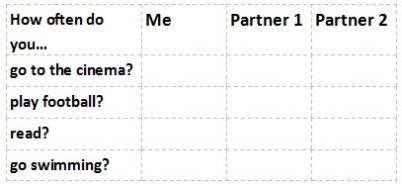
Make a series of questions or statements related to the topic. Have students answer the questions themselves. Then, they ask their partner the questions and compare answers. They could do this with two different partners to add more speaking. They could even predict their partners answers first, and see if they were right.
- Classic ‘Find someone who…’ mingle
Example topic: fears/phobias

- Slow reveal…
‘A snake’, ‘a line’, etc.
Encourage creativity. Add the next line, encourages guesses, keep doing this until eventually a student guesses the picture/lesson topic
Example topic: Castles in Britain

- Realia
Bring in 5 items that represent your own hobbies, can students guess pastimes?
Mine – Bit of wool (knitting), keyboard (blogging), crossword, binoculars (birdwatching), rubber chicken (making jokes)
- what happens next?
Example topic: using modal verbs to express probability
Pause clip after 7 seconds. Students discuss what might happen. Give some process language (that player might… it might… maybe… the ball/the player/a fan will… etc). Or give them 3 options for what might happen. Play clip to see if prediction was correct (note: last 10 seconds of this video has some swearing).
- Use authentic listening
Example topic: feelings/emotions
Listen to the following clip. Write down any emotions you feel the speakers express.
Or
Listen to the clip. Circle all the emotions that speakers show
Excitement anger patience shock humour etc
Now let them watch the clip and write down any extra emotions they ‘see’
- Make your own audio
Example topic: giving advice
- Matching quiz
Example topic: passives
Match the inventions to the inventor…
The light bulb was invented by… Alexander Graham Bell
The telephone was invented by… Tim Berners-Lee
The internet was invented by… Thomas Edison
Etc…
- Boggle guess the word
Example topic: Solar System – the planets
- Moving true or false
- Moving agree/disagree
Stand near the door if you agree
Stand in the corner over there (point) if you strongly agree
Stand near Pedro’s desk if you disagree
Etc
Read a statement, students move to the relevant corner, then give them 1 or 2 minutes to discuss the statement with whoever is in the corner. If there is only one person in a particular space then you could bounce a few ideas from each corner as a class discussion, or send a student with a different opinion over to debate it.
- Dingbats
Example topic: technology.
Draw a few dingbats on the board. Students guess the words then guess what the theme of the lesson might be.

(smart phone)
- Discussion questions
Q1: Do you agree with the death penalty?
Q2: ‘life means life’. What does this refer to, and do you agree?
Etc.
- Secret realia
- ‘Coffeepotting’
Example topic: television
Coffeepot was invented in the 1920s, but became popular after World War 2. At first, coffeepots were black and white, but then it changed to colour. Coffeepot is a form of entertainment. These days, almost every household has a coffeepot. (etc…)
- Verbal ‘coffeepotting’
Example topic: MacDonalds
Student: is coffeepot a noun?
Teacher: yes…
Student: can coffeepot be a verb too?
Teacher: no
Student: is coffeepot an object?
Teacher: well, you can have a coffeepot, yes.
Student: is it a place?
Teacher: is what a place?
Student: sorry, is coffeepot a place?
Etc…
- Complete the dialogue (similar to ‘what are they saying’!)
Example topic: how and when to apologise

Man: _______________________________
Woman: ____________________________
- Mnemonic race
Example topic: Feelings
F –antastic
E –xcellent
E – lated
L –azy
I – nsecure
N- auseous!
G- utted
S –tupid
- Whiteboard race
- Categorising
Example topic: health and fitness
Smoking, running, drugs, red wine, football, movies, reading, clubbing, vitamins, snakes, vegetables, birdwatching
Possible student created categories:
Things that benefit your health Things that damage your health unrelated words
(playing) football clubbing (too much) snakes
Smoking (relieve stress) drugs
Reading (relaxation) etc
With this activity, you’ll be surprised at some of the categories. Also, it leads to instant discussion:
‘Snakes are not unrelated, they could seriously damage your health’
‘Smoking is good for you?! No way!’
Etc
- What does that mean?
Example topic: lookalikes
Definitions…
Group 1: like a look (?)
Group 2: to look like something or someone
Group 3: look and act like something
Group 4: be person not you famous (?)
- Organise and discuss
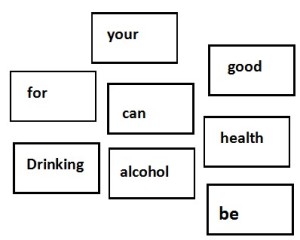
If the topic is particularly familiar or the learners are high level, get them to think of the statement and create the organisation task (statement minimum 8 words or something).
- odd one out
Board 4 or 5 common words related to the topic. Have students decide which word is the odd one out and why. Example topic: jobs/ambitions
Fireman Doctor Teacher Nurse
Student: the odd one out is the teacher as the others save lives
For guessing the topic…
Same thing, but include one word that is not related at all, and see if students mention the topic when they share their opinion!
Example topic: Endangered animals
T-rex dodo rhino woolly mammoth
Student: rhino is the odd one out as the others are extinct
(leads into a discussion on things like threats rhinos might face and introducing term ‘endangered’.
- A conundrum
Topic: giving opinions
Recently, a teacher recommended the ‘do or die’ videos by National Geographic. You’ll find plenty of these on youtube. Choose one relevant to your topic.. here’s an example of one.
- Hangman!
See more at :
http://eltplanning.com/2015/06/22/35-ways-to-introduce-your-lesson-topic/
Assinar:
Postagens (Atom)